00 Practice Lab
Chapters covered: 06-15 | Focus: P&L margins, FCF, Graham number, Altman Z, annual report reading
Use this lab after reading the chapters. Work on paper, Excel, or Screener.in before checking answers.
Visual Learning
Practical Examples (Indian Market)
Example A - Apply the Core Formula
Pick any NSE-listed company from this part's topic (P&L, Balance Sheet, Cash Flow, Annual Report). Pull latest annual report or Screener data and compute the main ratio/formula from each chapter. Build a one-page cheat sheet.
Example B - Good vs Bad Comparison
| Strong Signal | Weak Signal | ||
|---|---|---|---|
| Trend | Improving 3-5 years | Declining 2+ years | |
| vs Peers | Top quartile in sector | Bottom quartile | |
| Cash vs Profit | FCF supports profit | FCF much less than PAT | |
| Management | Transparent, low pledge | Opaque, high pledge | ### Example C - Decision Drill |
Scenario: You have Rs. 2 lakh to deploy. Using only concepts from Part 02, would you buy at full size, use 3 tranches, or wait in cash? Write 3 bullets defending your choice.
Mini Case Study
Company: Choose one Indian listed firm relevant to this part.
- Thesis - 3 sentences: why business is good or bad
- Numbers - 5 metrics from this part
- Verdict - Buy / Hold / Avoid / Watchlist
- Invalidation - 2 events that break your thesis
Practice Questions — Chapter Drills
Complete after reading each chapter's Practice Questions. Open the chapter Answer Key to verify.
- Ch 06 Profit & Loss Statement: Revenue ₹1,000 Cr, PAT ₹110 Cr — Net margin?
- Ch 07 Balance Sheet INTRODUCTION: Balance Sheet Intro — what is the core message of this chapter in one sentence?
- Ch 08 Balance Sheet Practical: Balance Sheet Practical — what is the core message of this chapter in one sentence?
- Ch 09 Balance Sheet Profitability: Balance Sheet Profitability — what is the core message of this chapter in one sentence?
- Ch 10 Balance Sheet Deep Dive: Balance Sheet Deep Dive — what is the core message of this chapter in one sentence?
- Ch 11 Graham Number: EPS ₹20, Book Value ₹100 — Graham Number?
- Ch 12 Altman Z-Score: Altman Z-Score — what is the core message of this chapter in one sentence?
- Ch 13 Cash Flow Statement: Cash Flow Statement — what is the core message of this chapter in one sentence?
- Ch 14 Annual Report Analysis: Annual Report Analysis — what is the core message of this chapter in one sentence?
- Ch 15 MD&A: Mda Management Discussion — what is the core message of this chapter in one sentence?
Answer Key (Lab)
How to self-check chapter drills
Strong answers: (1) cite formula + numbers, (2) name NSE/BSE source, (3) mention one red flag. Open each chapter's Answer Key section for model answers — do not skip showing your working.
Self-Assessment Checklist
- Completed at least 3 calculations on real Indian companies
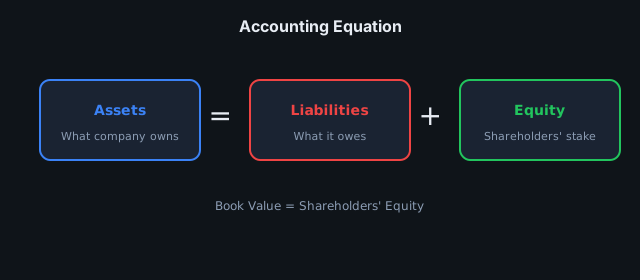
- Studied the diagram above without notes
- Can explain this part in 5 minutes to a friend
- Found 1 red flag in the wild using these tools
- Completed FAQ Drill (3+ answers without peeking)
- Updated investment journal with one entry
FAQ {#faq}
Use this section after reading chapter FAQs. Try answering without looking, then verify against the linked chapter.
Lab Workflow
Q: Practice lab — before or after reading chapters?
A: After — read the chapter + chapter FAQ first, try exercises without the answer key, then verify here.
Q: Is Screener.in enough, or is the annual report required?
A: For lab drills, Screener/Trendlyne is the start point; final verification must come from the consolidated annual report — CFA discipline.
Q: How do I score the Part 02 FAQ Drill?
A: 6+ accurate out of 8 drills = ready for the next part; 4–5 = re-read weak chapters; <4 = repeat the lab + FAQ index.
Q: What is the difference between Chapter FAQ and Lab FAQ?
A: Chapter FAQ = concept clarity (5 Q per chapter); Lab FAQ = synthesis across Part 02 (06-15).
Chapter FAQ Quick Index
| Ch | Chapter | Top FAQ Question | |:--:|---------|------------------| | 06 | Profit & Loss Statement — Margin Stack and Earn… | Revenue growth without PAT growth — red flag? | | 07 | Balance Sheet Introduction — Assets, Liabilitie… | Assets = Liabilities + Equity — why does it matter to investors? | | 08 | Balance Sheet Practical — Ratios, Working Capit… | Current ratio < 1 — always bad? | | 09 | Balance Sheet Profitability — ROE, ROCE, and Du… | ROE >> ROCE consistently — meaning? | | 10 | Balance Sheet Deep Dive — Quality of Earnings Link | After reading the Balance Sheet, what should I check second? | | 11 | Graham Number Introduction — Fair Value Screening | What should I check after Graham screening? | | 12 | Altman Z-Score — Financial Distress Screening (… | What should I check after Altman Z screening? | | 13 | Cash Flow Statement — CFO, FCF, and Earnings Qu… | What should I check alongside cash flow evaluation? | | 14 | Annual Report Analysis — CFA Reading Framework | What should I check alongside annual report evaluation? | | 15 | MD&A — Management Narrative vs Numbers | What should I check alongside MD&A evaluation? |
FAQ Drill — Test Yourself
Answer in 2–3 complete sentences in English, then open the chapter FAQ link to check.
- Ch 06: Revenue growth without PAT growth — red flag?
- Ch 07: Assets = Liabilities + Equity — why does it matter to investors?
- Ch 08: Current ratio < 1 — always bad?
- Ch 09: ROE >> ROCE consistently — meaning?
- Ch 10: After reading the Balance Sheet, what should I check second?
- Ch 11: What should I check after Graham screening?
- Ch 12: What should I check after Altman Z screening?
- Ch 13: What should I check alongside cash flow evaluation?
- + 2 more in Chapter FAQ Quick Index
FAQ Answer Key (Lab)
Drill guidance — how to self-check
Strong answers: (1) cite a number or formula, (2) name one NSE/BSE example, (3) mention one red flag. Weak answers: vague definitions only. Re-do drills for chapters you missed.
Go Deeper
| Resource | Link |
|---|---|
| Part chapters | _README.md |
| Formulas | CHEATSHEET.md |
| Action lists | CHECKLIST.md |
| Stock analyzer | tools/stock-analyzer |
Disclaimer: Educational content only. Not investment advice.