Financial Freedom Blueprint — From SIP to Passive Income
Learning Objectives
After reading this chapter, you will be able to:
- Apply: A monthly SIP of ₹40,000 at 12% CAGR over 20 years of disciplined investing can theoretically build a corpus of ₹4 crore+. The secret formula is simple: Amount × Time × Discipline
- Apply Financial Freedom Blueprint metrics and formulas using consolidated NSE/BSE annual report data
- Identify red flags when interpreting Financial Freedom Blueprint: stopping SIP mid-way (especially during a market crash)
- Connect Financial Freedom Blueprint analysis to peer comparison and buy/hold/avoid decisions
Introduction
Most people work their entire lives. Some work for money; a smaller group reaches the point where money works for them. That state is Financial Freedom.
Financial Freedom does not mean becoming a crorepati. It means:
When your Passive Income exceeds your expenses.
Core Concepts
Financial Terms
| Term | Meaning |
|---|---|
| SIP (Systematic Investment Plan) | Fixed-amount investment at regular intervals (monthly/quarterly) |
| CAGR | Compound Annual Growth Rate — average annual compounded return |
| Corpus | Total accumulated investment value |
| Compounding | Earning returns on prior returns — the accelerator of wealth |
Investment Decision
SIP is not about market timing; it is about time in the market.
Action framework:
- Build emergency fund first (6–12 months of expenses)
- Set a fixed monthly SIP amount
- Enable auto-debit
- Maintain a minimum 10–15 year horizon
- Review annually — do not panic monthly
Financial Terms
| Term | Meaning |
|---|---|
| Savings Rate | The percentage of income that is invested |
| Investment Return | Compounded growth of the portfolio |
| Time Horizon | Years available to build wealth |
| Churn | Frequent buy/sell activity — weakens returns through tax and costs |
Investment Decision
Plan for 10 years — not 10 days.
10-Year Wealth Plan:
- Define target corpus
- Fix monthly savings amount
- Set asset allocation (equity-heavy for long horizon)
- Rebalance annually — not daily trading
- Track progress — do not react in panic
Financial Terms
| Term | Meaning |
|---|---|
| Passive Income | Recurring cash flow with minimal active work |
| Active Income | Salary, business labour — time exchanged for money |
| 4% Rule (Safe Withdrawal Rate) | Guideline to withdraw ~4% of retirement corpus annually |
| Inflation Risk | Erosion of purchasing power in fixed income |
Investment Decision
Passive Income Build Plan:
- Calculate annual expense (inflation-adjusted)
- Apply 4% rule → target corpus
- Build income layers: dividends + debt + optional rental/REIT
- Reinvest until crossover point: Passive Income > Expenses
- Protect corpus — don't chase yield blindly
Financial Terms
| Term | Meaning |
|---|---|
| Dividend | Profit distribution by a company to shareholders |
| Dividend Yield | Annual DPS ÷ Share Price |
| Payout Ratio | Dividend ÷ Net Profit — sustainability indicator |
| Dividend Trap | Artificially high yield caused by a falling price |
| FCF (Free Cash Flow) | Cash available after capex — real dividend source |
Investment Decision
Dividend Portfolio Framework:
- Define target annual passive income
- Quality-first stock list — yield second
- 8–15 stocks across sectors
- Quarterly: payout ratio + FCF review
- Reinvest dividends until income goal is reached
Financial Terms
| Term | Meaning |
|---|---|
| Emergency Fund | 6–12 months expenses — liquid, safe |
| Term Insurance | Pure life cover — wealth protection |
| Asset Allocation | Equity / Debt / Gold / Cash mix |
| Estate Planning | Will, nomination — wealth transfer |
| Lifestyle Inflation | Expenses rise with income — savings rate stays stagnant |
Investment Decision
Final Framework:
| Phase | Age Band | Focus |
|---|---|---|
| Foundation | 25–35 | Emergency fund, term cover, start SIP |
| Accumulation | 35–50 | Maximize savings rate, equity growth |
| Transition | 50–60 | Rebalance, build passive income |
| Preservation | 60+ | Capital protection, sustainable withdrawal |
Compounding is not the world's most powerful force — Disciplined Compounding is.
"Financial Freedom is not about being rich. It is about having control over your time."
- ₹40,000 SIP Plan
- 10 Year Wealth Creation
- Passive Income
- Dividend Portfolio
- Financial Freedom Roadmap
"Small amounts invested consistently create extraordinary wealth."
Assumptions: SIP = ₹40,000/month | CAGR = 12% | Period = 20 years
| Period | Estimated Corpus |
|---|---|
| 10 years | ₹92 lakh |
| 15 years | ₹2 crore |
| 20 years | ₹4 crore+ |
| 25 years | ₹7 crore+ |
| 30 years | ₹14 crore+ |
Note: These are illustrative projections; actual returns will be affected by market volatility, fees, and tax.
- Dividends — distribution of listed company profits
- Rental Income — real estate
- Bonds / Fixed Income — interest income
- REITs — real estate exposure with liquidity
- Business Ownership — equity stake, not salary
- ✅ Strong, recurring Cash Flow
- ✅ Manageable Debt
- ✅ Stable, predictable Profit
- ✅ High ROE with reinvestment balance
- ✅ Moderate, sustainable Payout Ratio
High Dividend Yield is not always a good signal. If:
- Profit is declining
- Business is structurally weak
- Stock price crash makes yield appear artificially high
→ Dividend Trap — yield looks attractive, capital loss is devastating.
Analyst rule:
Look at Sustainability, not Yield.
Check order: FCF → Payout Ratio → Debt → Business Moat → Yield
Step 1: Emergency Fund
Keep 6–12 months of expenses in a liquid account or liquid fund.
Step 2: Insurance
- Term Insurance — life cover
- Health Insurance — medical emergency buffer
Step 3: Become Debt-Free
Eliminate high-interest debt first (credit card ~36–48% APR).
Step 4: Regular Investing
Invest a minimum of 30–40% of income.
Step 5: Asset Allocation
| Asset | Allocation |
|---|---|
| Equity | 60% |
| Debt | 25% |
| Gold | 10% |
| Cash | 5% |
Adjust for age, risk tolerance, and goals.
Step 6: Passive Income Build
Target: Passive Income > Expenses
Step 7: Wealth Protection
- Estate Planning
- Nomination (bank, MF, demat)
- Will — legal clarity
**Knowledge teaches you how to invest.
Discipline makes you wealthy.**
**Compounding is not the world's most powerful force —
Disciplined Compounding is.**
Disclaimer: This is educational content, not investment advice. Past performance does not guarantee future returns. Consult a qualified financial advisor before investing.
— End —
Formula & Explanation
SIP Future Value (Monthly Investment)
FV = PMT × ((1 + r)^n − 1) / rWhere:
- PMT = monthly investment (₹40,000)
- r = monthly return (12% annual ≈ 1% monthly = 0.01)
- n = total months (20 years = 240)
Wealth Building Rule
Corpus ≈ Savings Rate × Investment Return × TimeThe product of all three factors builds long-term corpus.
Three Pillars of Wealth Creation
- Savings Rate
- Investment Return
- Time
Illustrative Example
- Initial investment = ₹10 lakh
- Annual investment = ₹5 lakh
- CAGR = 12%
- Period = 10 years
→ Corpus can reach crores (combined effect of compounding + regular additions).
Rule of 72
Years to Double ≈ 72 / Annual Return (%)Example: At 12% return:
72 / 12 = 6 yearsMeaning capital can roughly double in 6 years — provided the return is sustained.
Financial Freedom Condition
Passive Income > Annual Expenses4% Rule — Required Corpus
Required Corpus = Annual Expenses / 0.04Example: Monthly expense ₹1 lakh → Annual expense ₹12 lakh
Required Corpus = ₹12,00,000 / 0.04 = ₹3 croreCFA caveat: The 4% rule is based on US historical data; in India you must adjust for inflation (~5–6%), tax (STCG 20% on equity held ≤12 months; LTCG 12.5% above exemption on equity held >12 months; dividends taxable at your income slab rate with no DDT), healthcare costs, and longevity risk. Many analysts prefer a 3–3.5% withdrawal rate.
Dividend Yield
Dividend Yield = (DPS / Share Price) × 100Example: DPS = ₹10, Price = ₹200 → Yield = 5%
Payout Ratio (Sustainability Check)
Payout Ratio = (Dividend / Net Profit) × 100Payout > 80–90% consistently → dividend cut risk elevated.
Senior CFA Financial Freedom Framework — 5 Questions
- What is the Savings Rate?
- How much Corpus is required? →
Annual Expenses ÷ 0.04 - How much Passive Income exists currently?
- Is Inflation impact modeled?
- Is the Plan sustainable — behaviourally and financially?
Visual Guide
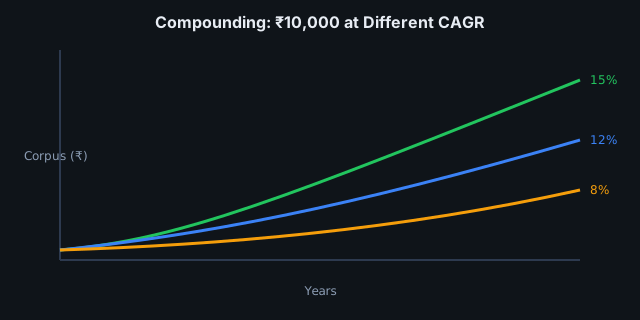
Worked Example — Indian Market
Example 1 - Freedom Gap
Target corpus vs SIP projection -> increase SIP or extend timeline.
Example 2 - SWP Bridge
Corpus x safe withdrawal rate = monthly passive income estimate.
Real World Example
Ravi, age 35. Monthly income ₹1 lakh, monthly expense ₹60,000 — savings ₹40,000.
He did no market timing or forecasting. He made only one decision:
I will invest ₹40,000 every month.
After maintaining discipline for 20 years, he became financially free. Ravi did not get rich overnight; he used Time × Discipline × Compounding.
Ravi allocated his SIP to a Nifty 50 Index Fund and a Large Cap Mutual Fund — broad market exposure instead of individual stock picking. In India, instruments such as SBI Nifty Index Fund, UTI Nifty 50 Index Fund, and HDFC Top 100 Fund are common retail choices for long-term SIP.
Individual stocks such as TCS and HDFC Bank can also be disciplined SIP candidates — but only when the investor understands fundamentals.
Two friends — Amit and Suresh — started investing at the same time.
- Amit: New strategy every year, new stocks, new tips — constant switching
- Suresh: Same disciplined plan for 10 years — regular investing, minimal churn
After 10 years, Suresh's wealth was several times higher. The difference was less about return and more about consistency.
Infosys (INFY) — long-term investors since the 1990s have seen exceptional wealth from decade-long holding. But this is hindsight bias; the CFA lesson is that quality business + long holding period + no panic selling is the engine of wealth, not a single stock tip.
For a moderate investor, a 10-year SIP in Nifty 50 or a Flexi Cap Fund is a realistic starting point.
Priya, age 42, monthly salary ₹1.5 lakh. She was fully dependent on active income — one month without salary meant crisis.
Over 8 years she built:
- Dividend stocks
- Debt funds / bonds
- One rental property (REIT exposure)
By year 12, her passive income crossed ₹80,000/month — active salary became optional, not mandatory.
Coal India Limited — historically a high-dividend-yield PSU; attractive to passive income seekers. But the analyst runs a yield trap check: why is yield high? Is the business declining?
Balanced approach: ITC + HUL + PFC mix — FMCG stability + PSU yield — with sector diversification.
Vikas bought a stock with 5% dividend yield — thinking "safe income." In 2 years, company profit fell 40%, dividend was cut, and the stock dropped 50%.
Lesson: High yield ≠ Safe income. Sustainability matters.
| Company | Sector | Analyst Note |
|---|---|---|
| ITC Limited | FMCG + Hotels | Consistent dividend history; monitor tobacco regulatory risk |
| Hindustan Unilever (HUL) | FMCG | Defensive cash flows; yield moderate, quality high |
| Coal India | Mining / PSU | High yield; commodity cycle + ESG transition risk |
| Power Finance Corporation (PFC) | NBFC / Power Finance | PSU yield play; monitor asset quality + DISCOM stress |
Disclaimer: Examples are illustrative, not buy recommendations. Always do independent analysis.
Anil, age 30, earned ₹80,000/month — zero savings discipline. At age 38 came a wake-up call: no emergency fund, credit card debt, no insurance.
He followed the 7-step roadmap. At age 50: debt-free, ₹2.5 crore corpus, ₹75,000/month passive income pipeline — on track for Financial Freedom.
Case Study
In the roadmap's Equity 60% block:
- Index Fund / ETF — core (low cost, diversified)
- Quality Dividend Stocks (ITC, HUL) — income layer
- Growth Compounders (TCS, Asian Paints) — wealth acceleration
Allocation shifts with age — equity-heavy in your 30s; increase debt in your 50s+.
CFA Exam Tip
A Senior CFA analyst treats SIP as a behavioural tool, not just a return tool:
- Emotional temptation to time the market is reduced
- Rupee Cost Averaging happens automatically
- Volatility impact smooths over a long horizon
Key insight: SIP success depends on continuity before return.
Wealth is built consistently, not quickly.
When evaluating a 10-year plan, CFA analysts ask:
- Is the savings rate sustainable, or is lifestyle inflation eroding it?
- Is the return assumption realistic (12% long-term equity assumption — historical average, not a future guarantee)?
- Is the portfolio diversified?
Behavioural edge: A 10-year horizon filters out short-term noise.
The real goal of Financial Freedom:
Work by Choice, not by Necessity.
Senior CFA framework:
- Are passive income streams diversified?
- Is inflation-adjusted return positive?
- Is emergency buffer separate?
- Is insurance coverage adequate?
- Is tax-efficient structure considered (e.g., STCG 20%, LTCG 12.5%, dividends at slab rate with no DDT)?
When building a dividend portfolio, CFA analysts:
- Avoid yield chasing
- Maintain sector diversification
- Track dividend growth rate (not just current yield)
- Factor tax on dividend income (India: taxable at slab rate for most investors; DDT abolished)
Financial Freedom is not a lottery outcome — it is a process outcome:
Earn → Save → Invest → Protect → Repeat
In a client plan review, a CFA analyst checks savings rate and insurance gap first — return discussion comes later.
Common Mistakes
- Stopping SIP mid-way (especially during a market crash)
- Changing strategy at every correction
- Abandoning a long-term plan based on short-term returns
- Starting aggressive SIP without an emergency fund
- "Quick rich" schemes and guaranteed return products
- Excessive trading — increases turnover tax and costs
- Leverage / margin trading — amplifies drawdown
- Changing plan every quarter — interrupts compounding
- 100% dependence on salary only
- Zero investments — inflation silently erodes wealth
- Setting nominal corpus targets while ignoring inflation
- "Passive" income that actually demands active management (bad rental, distressed dividend stocks)
- Payout ratio consistently > 90%
- Falling operating cash flow
- Rising debt funding dividends
- One-sector concentration (e.g., only high-yield PSUs)
- Buying solely on screener yield filter
- Lifestyle inflation — income ↑, savings flat
- Credit card debt at high APR
- Investing without plan or goal
- Excessive risk without emergency buffer
- No insurance — one event can wipe wealth
- No nomination / will — family legal complications
Key Takeaways
A monthly SIP of ₹40,000 at 12% CAGR over 20 years of discipline can theoretically build a corpus of ₹4 crore+. The secret formula is simple: Amount × Time × Discipline.
10 Year Wealth Creation — How Wealth Builds Over a Decade
"We overestimate what we can do in one year and underestimate what we can do in ten years."
10-year wealth is the product of Savings Rate + Return + Time. The Rule of 72 shows how fast capital can double. Discipline beats speculation.
Passive Income — When Money Works for You
"If you don't find a way to make money while you sleep, you will work until you die."
— Warren Buffett (popularly cited)
Financial Freedom = Passive Income > Expenses. ₹1 lakh/month expense → roughly ₹3 crore corpus (4% rule). Real freedom = time control, not just a rich label.
Dividend Portfolio — The Income Engine
"Dividends are the proof that profits are real."
Dividend investing = real cash proof of profits. Sustainable yield beats high yield. ITC, HUL, Coal India, PFC — study cases, not blind picks. Always ask: "Can this dividend survive a bad year?"
Financial Freedom Roadmap — The Path to Independence
"A goal without a plan is just a wish."
7-step roadmap: Emergency Fund → Insurance → Debt-Free → 30–40% Investing → Asset Allocation → Passive Income → Wealth Protection. Five CFA questions ensure the plan is realistic, not wishful.
Final Summary
| Topic | Key Takeaway |
|---|---|
| ₹40,000 SIP | 12% CAGR, 20 years → ₹4 Cr+ (illustrative) |
| 10-Year Wealth | Savings Rate + Return + Time; Rule of 72 |
| Passive Income | Income > Expenses; 4% Rule → ₹3 Cr for ₹1L/month |
| Dividend Portfolio | Sustainability > Yield; avoid dividend traps |
| Roadmap | 7 steps from safety to freedom |
Practice Questions
Chapter: Financial Freedom Blueprint | Part 14 | Try before reading answers.
Q1 (Conceptual): Financial Freedom Blueprint — what is the core message of this chapter in one sentence?
Q2 (Calculate): Apply formula: FV = PMT × ((1 + r)^n − 1) ÷ r — use numbers from this chapter.
Q3 (Application): How do SIP (Systematic Investment Plan) and CAGR interact in Financial Freedom Blueprint decisions?
Q4 (Red Flag): Red flag: stopping SIP mid-way during a market crash — why avoid relying on Financial Freedom Blueprint alone?
Q5 (CFA Style): CFA-style trap when interpreting Financial Freedom Blueprint?
Q6 (Decision): Invest / wait / avoid — 3 bullets using Financial Freedom Blueprint framework on one stock.
Q7 (Lab): Complete one Financial Freedom Blueprint exercise in Part 14 Practice Lab.
Answer Key
Q1 (Conceptual)
A monthly SIP of ₹40,000 at 12% CAGR over 20 years of discipline can theoretically build a corpus of ₹4 crore+. The secret formula is simple: Amount × Time × Discipline.
Q2 (Calculate)
Step-by-step substitution; verify consolidated annual report figures.
Q3 (Application)
Both must align — strong SIP (Systematic Investment Plan) with weak CAGR (or vice versa) needs deeper AR review.
Q4 (Red Flag)
Stopping SIP mid-way during a market crash breaks compounding continuity and turns a behavioural tool into a timing mistake.
Q5 (CFA Style)
A Senior CFA analyst treats SIP as a behavioural tool, not just a return tool — continuity matters more than chasing peak returns.
Q6 (Decision)
Justify with metric trend + valuation + balance-sheet quality; one ratio never enough.
Q7 (Lab)
See Part 14 Practice Lab and verify with lab Answer Key.
Go deeper: Part 14 Practice Lab
FAQ {#faq}
Q: Financial Freedom Blueprint — what is the second check when evaluating this concept?
A: Avoid changing strategy at every market correction — consistency beats reactive switching.
Q: How do you connect theory with Indian market practice for Financial Freedom Blueprint?
A: Pull the same metric's 3-year trend from Screener/Trendlyne plus the company annual report — a paper formula alone is not sufficient.
Q: financial-freedom-blueprint — why should you avoid this mistake?
A: Stopping SIP mid-way during a market crash — you miss the lowest-cost units and break long-term compounding.
Q: financial-freedom-blueprint — short-term returns vs long-term plan red flag — why avoid it?
A: Abandoning a long-term plan based on short-term returns confuses noise with signal and destroys discipline.
Q: How do I drill this chapter's concepts in the Practice Lab?
A: Open Part 14 Practice Lab → use the FAQ Drill row for financial-freedom-blueprint; verify answers in the Chapter FAQ Quick Index.
Practice Lab FAQ: Full part FAQ index — Part 14 Practice Lab
Related Topics
- Previous Chapter: 97-Pfc Rec Indian Cases
- Part Overview: Part 14 Financial Freedom
- Book Index: Full Table of Contents
Disclaimer: Educational content only. Not investment advice. Consult a qualified financial advisor before investing.