The Power of Compounding — SIP, Time Horizon, and Real Returns
"Compounding is the eighth wonder of the world. He who understands it, earns it; he who doesn't, pays it." — Attributed to Albert Einstein
Learning Objectives
After reading this chapter, you will be able to:
- Apply the Rule of 72 to estimate doubling time at any CAGR
- Calculate SIP future value using the standard annuity formula
- Quantify the wealth cost of delayed investing (5-year and 10-year gaps)
- Explain why time horizon often beats contribution amount in compounding
- Distinguish nominal returns from real returns in the Indian inflation context
Introduction
If you master one principle from this book, make it compounding. It is not merely a mathematical concept — it is the force that converts ordinary salary income into extraordinary long-term wealth.
Most people spend years searching for the "right stock," but the secret of lasting wealth is often hidden in time + compounding, not stock-picking alone. Successful investors do not chase the highest return for one year — they give their investments enough time to multiply.
On the NSE and BSE, the investors who built crores of rupees through HDFC Bank, Asian Paints, or a simple Nifty index fund did so by staying invested through decades — not by timing every rally.
Core Concepts
Financial Terms
| Term | Meaning |
|---|---|
| Principal | Original amount invested |
| Simple Interest | Return calculated on principal only |
| Compound Interest | Return calculated on principal plus accumulated returns |
| CAGR | Compound Annual Growth Rate — smoothed annual return over multiple years |
| SIP | Systematic Investment Plan — regular periodic investment (e.g., monthly) |
| FV / PV | Future Value / Present Value |
| Rule of 72 | Quick estimate: Years to double ≈ 72 ÷ CAGR (%) |
| Nominal Return | Stated return before inflation adjustment |
| Real Return | Nominal return minus inflation — measures purchasing power growth |
| Dividend Reinvestment | Using dividends to buy more shares — accelerates compounding |
Investment Decision
Rule 1: Preserve capital. Rule 2: Do not interrupt compounding.
Practical Rules:
- Start early — even small amounts compound powerfully over 20–30 years
- Invest regularly — SIP discipline removes timing anxiety
- Select quality businesses that reinvest earnings at high ROCE
- Avoid unnecessary trading — every exit resets the compounding clock
- Commit a minimum 10–15 year horizon before expecting hockey-stick growth
Disclaimer: Projected figures are illustrative; actual returns are volatile. Past performance does not guarantee future results.
SIP Wealth Projection — ₹10,000/month at 15% CAGR
| Tenor | Total Invested | Estimated Value |
|---|---|---|
| 5 years | ₹6 lakh | ₹9 lakh |
| 10 years | ₹12 lakh | ₹28 lakh |
| 15 years | ₹18 lakh | ₹67 lakh |
| 20 years | ₹24 lakh | ₹1.5 crore |
| 25 years | ₹30 lakh | ₹3.3 crore |
| 30 years | ₹36 lakh | ₹7 crore+ |
Pattern: The first 10 years show moderate growth; the last 10 years show explosive acceleration — the classic hockey-stick effect of compounding.
Compounding Drivers
| Factor | Role |
|---|---|
| Time | The most critical multiplier — cannot be replaced by larger later contributions |
| Return | Even small CAGR gaps produce large outcome differences over decades |
| Discipline | Regular investment without interruption; missed months permanently reduce corpus |
| Patience | Premature exit = compounding interrupted |
Self-Assessment Exercise:
- Write your monthly investment capacity
- Calculate 20-year wealth at 10%, 15%, and 20% CAGR
- Set a target financial freedom amount
- Estimate how many years to reach it at your current savings rate
- Identify your biggest obstacle: time, discipline, capital, or knowledge?
Formula & Explanation
Lump Sum Compounding
FV = PV × (1 + r)^nWhere FV = Future Value, PV = Present Value, r = annual return (decimal), n = number of years
Simple vs Compound — ₹1,00,000 at 10% for 10 years
Simple Interest: ₹1,00,000 + (₹10,000 × 10) = ₹2,00,000
Compound Interest: ₹1,00,000 × (1.10)^10 ≈ ₹2,59,374
Difference: ₹59,374 — compound interest earns "interest on interest."
SIP Future Value (End-of-Period Annuity)
FV = PMT × ((1 + r)^n − 1) ÷ rWhere PMT = periodic payment, r = return per period, n = total number of periods
For monthly SIP with annual CAGR, convert: monthly rate = (1 + annual CAGR)^(1/12) − 1
Rule of 72
Years to Double ≈ 72 ÷ CAGR (%)| CAGR | Approx. Years to Double |
|---|---|
| 8% | 9 years |
| 12% | 6 years |
| 15% | ~5 years |
Real Return (Indian Context)
Real Return ≈ Nominal Return − Inflation RateExample: 12% nominal − 6% inflation ≈ 6% real purchasing power growth
CAGR Impact — ₹1 Lakh Lump Sum, 25 Years
| CAGR | Future Value |
|---|---|
| 10% | ₹10.8 lakh |
| 15% | ₹32.9 lakh |
| 20% | ₹95 lakh |
Visual Guide
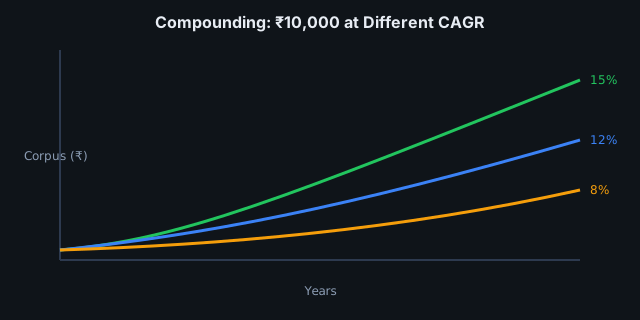
Worked Example — Indian Market
Deep Walkthrough: Priya's 20-Year SIP Plan
Profile: Priya, age 28, salary ₹80,000/month, invests ₹15,000/month in a Nifty index fund via SIP.
Step 1 — SIP future value (12% CAGR assumption)
Monthly PMT = ₹15,000 | n = 240 months | r ≈ 0.9489% per month (12% annual)
FV = PMT × ((1+r)^n − 1) / r × (1+r)
FV ≈ ₹1.48 crore
Total invested = ₹36 lakh → Wealth multiple ≈ 4.1×
Step 2 — Cost of waiting 5 years
Start at 33 instead of 28 (same ₹15,000/month SIP, stop at 48):
- Corpus at 48 ≈ ₹75 lakh vs ₹1.48 crore if started at 28
- Lesson: A 5-year delay costs roughly 50% of final wealth — time cannot be bought back.
Step 3 — Rule of 72
At 12% CAGR, money doubles every 72 ÷ 12 = 6 years. Over 30 years, that is ~5 doublings.
Real World Example
Person A — Age 25, ₹10,000/month SIP, 30 years, 15% CAGR assumption.
Person B — Age 40, ₹20,000/month SIP, 15 years, same 15% CAGR.
Person B invests double the monthly amount but starts 15 years later. Final wealth is typically in favour of Person A — time beats amount.
10-year delay (start at 25 vs 35): Same ₹10,000/month, same return — the 10-year head start can produce a ₹1 crore+ difference in final corpus.
| Start Age | Monthly SIP | Years | Illustrative Corpus (15% CAGR) |
|---|---|---|---|
| 25 | ₹10,000 | 30 | ~₹7 crore |
| 35 | ₹10,000 | 20 | ~₹1.5 crore |
Case Study
Quality businesses become compounding machines when they reinvest earnings at high returns:
| Company | Compounding Driver |
|---|---|
| HDFC Bank, ICICI Bank | Reinvested deposits into high-ROE lending |
| HUL, ITC, Asian Paints | Consumer franchises with pricing power |
| BEL, HAL | Defence order-book visibility, government contracts |
| TCS, Infosys, HCL Tech | Asset-light IT services, high ROCE |
Warren Buffett: A large portion of his net worth was created after age 50 — not from exceptional talent or excessive risk, but from decades of uninterrupted compounding in quality businesses.
Counter-case: Holding a poor business for 20 years does not create wealth — time destroys capital in value traps. Compounding works with quality, against mediocrity.
CFA Exam Tip
Equity compounding sources:
Wealth = f(Earnings Growth, Valuation Expansion, Dividend Reinvestment)CFA perspective:
- Retail investors' edge = time horizon, not alpha generation
- "I'll invest when income rises" is the most expensive thought; early start beats large late start
- Quality matters: time amplifies good businesses and punishes bad ones
- Transaction costs (STT, brokerage, capital gains tax, bad timing) are compounding enemies
Financial Freedom Illustration: ₹40,000/month SIP at 15% CAGR for 20 years → total investment ₹96 lakh → portfolio ₹3 crore+. Financial freedom is the result of disciplined investing + compounding, not salary alone.
Exam tip: Know the difference between arithmetic mean return and geometric mean (CAGR). Compounding uses geometric returns.
Common Mistakes
- Frequent buy-sell — taxes, brokerage, and bad decisions compound negatively
- Panic selling in corrections — breaks the compounding chain at the worst time
- Holding a bad business long-term — time destroys, not creates, wealth in value traps
- Waiting for the "perfect time" to start — every year of delay has permanent opportunity cost
- Stopping SIP during market falls — misses buying at lower NAVs
- Abandoning a long-term plan after one year of underperformance
- Confusing nominal 15% returns with real ~9% after 6% inflation
Key Takeaways
- Compounding is the most powerful force in long-term investing.
- Time in the market matters more than timing the market.
- Early start is the biggest free advantage — it cannot be replicated by larger later contributions.
- Regular SIP accelerates compounding through rupee-cost averaging.
- Quality businesses become long-term compounding machines when earnings are reinvested at high ROCE.
- Patience and discipline are non-negotiable — interrupting compounding is costly.
- Financial freedom is built on compounding, not salary alone.
- Real returns = nominal returns minus inflation — always think in purchasing power.
Practice Questions
Chapter: Compounding Power | Part 01 | Try before reading answers.
Q1 (Calculate): Rs. 5,000/month SIP 15 years at 12% — approximate corpus?
Q2 (Rule of 72): Years to double at 8%, 12%, 15%?
Q3 (Real Return): 12% nominal minus 6% inflation?
Q4 (Red Flag): Compounding in a bad business long hold?
Q5 (CFA Style): Why early SIP start beats larger late start?
Q6 (Lab): Part 01 Practice Lab compounding exercise.
Answer Key
Q1 (Calculate)
About Rs. 25 lakh on Rs. 9L invested
Q2 (Rule of 72)
9, 6, ~5 years
Q3 (Real Return)
About 6% real
Q4 (Red Flag)
Time destroys wealth — quality business essential
Q5 (CFA Style)
Time in market > timing; compounding needs years
Q6 (Lab)
Go deeper: Part 01 Practice Lab
FAQ {#faq}
Q: What happens when you hold a bad business and expect compounding?
A: Time destroys wealth in value traps. Compounding works with quality businesses that reinvest at high returns — not with declining firms.
Q: Why is stopping a SIP mid-way so costly?
A: Missed months break the compounding chain permanently. Restarting later produces a smaller corpus at the same retirement age.
Q: What is a quick use case for the Rule of 72?
A: 72 ÷ CAGR = years to double. At 12% CAGR, money doubles in ~6 years — useful mental math for SIP planning.
Q: Real return vs nominal return — Indian context?
A: Nominal 12% minus ~6% inflation ≈ 6% real return — this measures actual purchasing power growth, not headline returns.
Q: How do I drill concepts from this chapter in the Practice Lab?
A: Open Part 01 Practice Lab → FAQ Drill section → find the compounding-power row → complete the real-stock exercise → verify answers in Chapter FAQ Quick Index.
Practice Lab FAQ: Full part FAQ index — Part 01 Practice Lab
Related Topics
- Previous Chapter: 02-Investment Psychology
- Next Chapter: 04-What Is A Share
- Part Overview: Part 01 Foundations
- Book Index: Full Table of Contents
Disclaimer: Educational content only. Not investment advice. Consult a qualified financial advisor before investing.